A vibrant venue where performances and culinary delights meet.
A bit of history
Since 1916, Espace St-Denis has pulsed to the rhythm of the Latin Quarter. As a front-row witness to Montreal’s artistic evolution, our complex has hosted the greatest icons and the boldest productions, while staying true to its mission: making culture accessible to all.
Théâtre St-Denis – 110 Years of History
To celebrate this milestone anniversary, we invite you to go behind the scenes of our collective memory through a unique historical journey located right in the heart of the Théâtre St-Denis lobby. Created in collaboration with the Canada Research Chair in Urban Heritage at UQAM, this permanent exhibition offers a chronological tour of twelve key moments that have defined our identity—from our early beginnings in 1916 to today's technological feats.
This exhibit is a vibrant tribute to the renowned artists and landmark productions that have brought our stage to life and moved generations of audiences. Designed as an accessible, self-guided experience, it allows you to explore our heritage at your own pace during your next visit.
1910
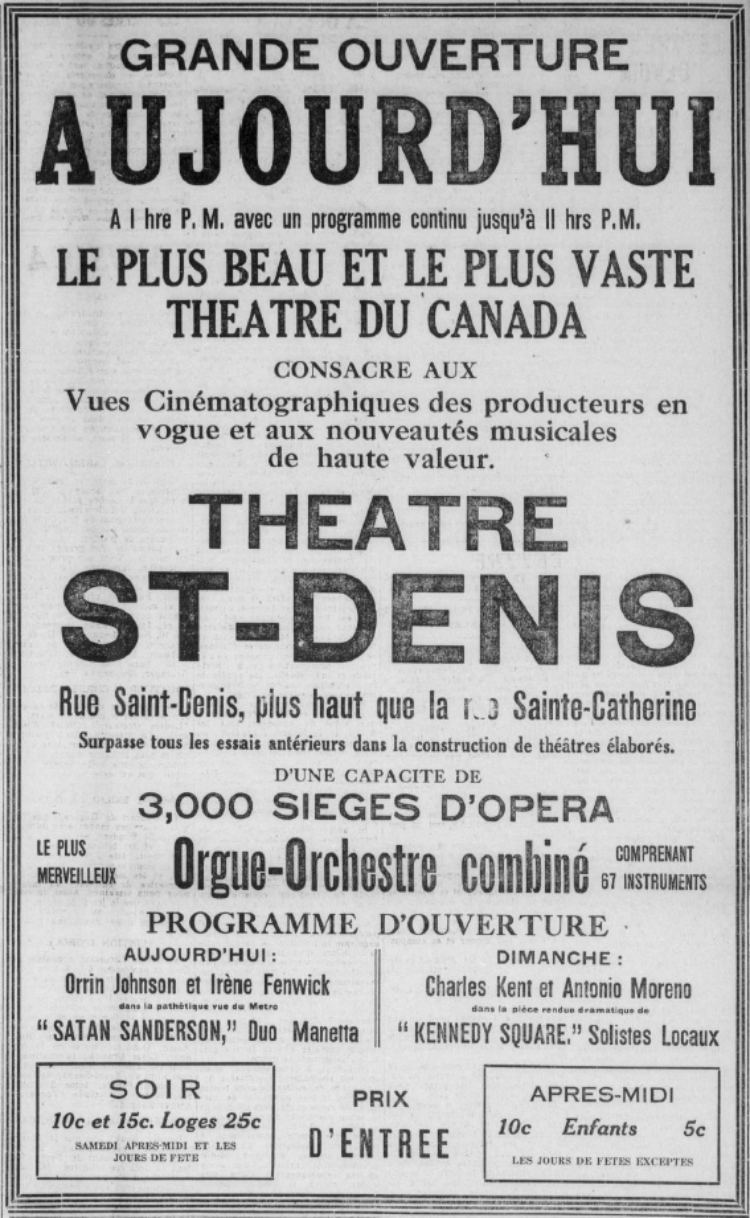
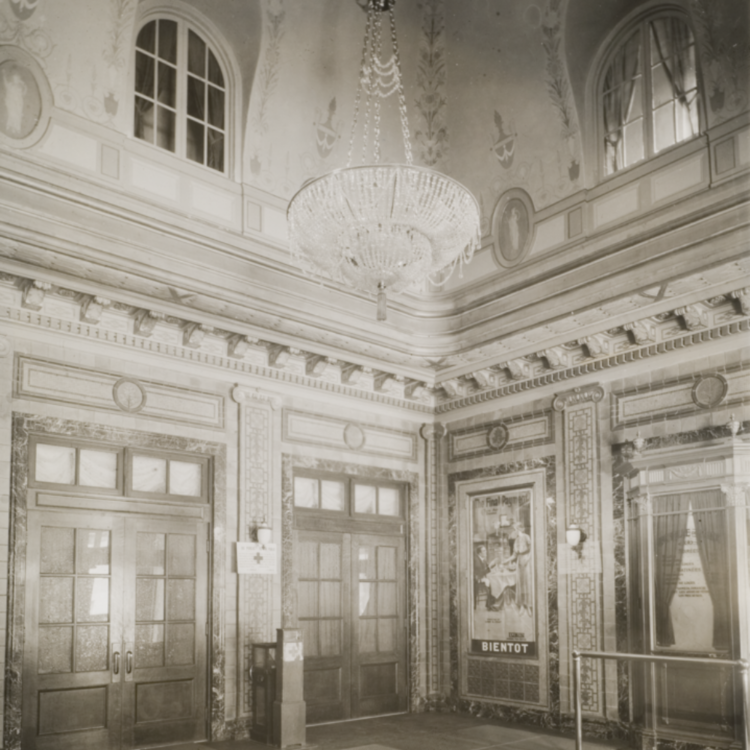
Théâtre St-Denis opened its doors on Friday, March 4, 1916! Montreal’s elite flocked to admire the luxury and comfort of this new performance venue, which could accommodate up to 3,000 people and featured a sloped floor ensuring clear sightlines of the stage from every seat. The public was particularly impressed by the building’s modern architecture and its décor, featuring grotesque motifs in shades of cream, azure, and gold¹. According to the newspaper Le Nationaliste, the crowd was 'delighted on Friday evening; they hardly knew which to admire more: the luxurious scenery and ornamentation, or the musical program, for which they could not withhold their warm applause².'
The inauguration was such a resounding success that in just three days, over 30,000 spectators arrived to attend screenings of the silent films Satan Sanderson, depicting the strained relationship between a bitter father and his rebellious son, and Kennedy Square, portraying the American Southern aristocracy³. The public was also pleasantly surprised by the prominence the theatre's administration gave to the French language. Indeed, the management aimed to establish the venue as an essentially Francophone institution by hiring French-Canadian ushers and staff, as well as providing signage and film captions in French. Although a few translation errors slipped into the descriptions, the place of the French language within the establishment delighted the public and showed that Théâtre St-Denis 'understands the legitimate demands of its clientele' in a city that was two-thirds Francophone⁴.
1915-1916
The plans for Théâtre St-Denis were designed by the talented and prolific architect Ernest Isbell Barott. Located in the heart of the Latin Quarter—the hub of Montreal’s Francophone intelligentsia—this new temple of entertainment was, first and foremost, an act of urban integration. To harmonize with the rhythm of the surrounding terraced buildings, the architect set the massive volume of the hall well back from the street, fronting it with an elegant portico. This structure was designed to house shops on either side of the theatre lobby, ensuring continuity with the neighboring buildings.
Rooted in the Beaux-Arts style (named for the influence of the École des Beaux-Arts in Paris), much like its graceful interior décor, the complex’s meticulous brick design employs an elaborate classical vocabulary: the monumental Ionic pilasters of the central section echo the Doric order that defines the arcades of the side wings, which are topped with acroterion-style light fixtures.
1920
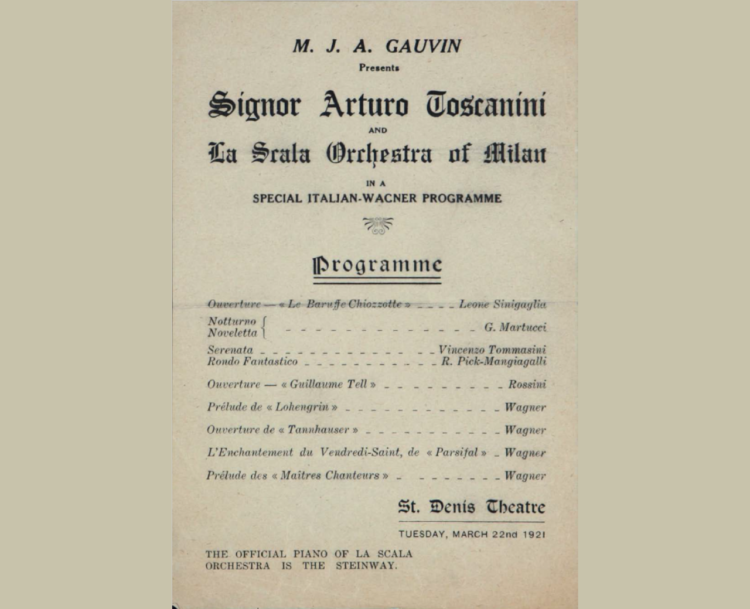
In the 1920s, Théâtre St-Denis welcomed crowds of Montrealers seeking entertainment. To satisfy public demand, it hosted major names from the worlds of theatre and music, including Arturo Toscanini, conductor of the famous Scala di Milano. While in North America for a concert tour, the conductor stopped in Montreal on March 22 and 24, 1921—much to the delight of the local population—before returning to Europe. The excitement was further bolstered by a reduction in ticket prices, which dropped from $3 to $1, allowing music lovers to attend the performances.
Thus, before a massive audience, the conductor and his musicians performed pieces of modern Italian music as well as German works by Wagner. The newspaper La Patrie noted that the success was undeniable, as "almost [every piece] on the program [was] met with applause, loud cheers, and even the enthusiastic stamping of feet." The pleasure was unexpectedly extended for a third evening when the departure of the ocean liner scheduled to take the musicians back to Europe was delayed by six days, allowing even more people to experience the music of the famous Milanese orchestra.
1930
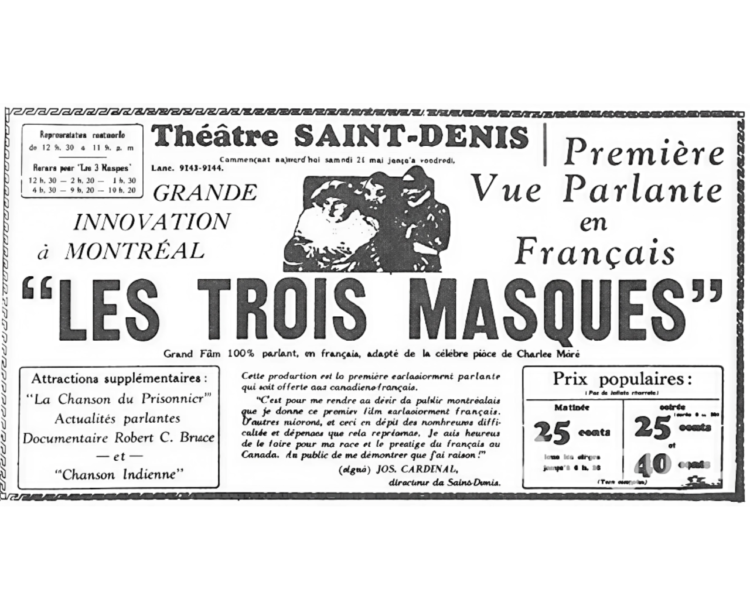
May 31, [1930], will mark a milestone in the city's cinematic annals [i]," as the Théâtre St-Denis presents Montreal’s very first French-language talking picture! The film Les Trois Masques, a cinematic adaptation of Charles Méré’s famous play, inaugurated the brand-new sound reproduction system installed by the theatre's director, Mr. Joseph Cardinal. The latter set up a series of giant loudspeakers specifically designed to perfectly transmit both dialogue and sound [ii]. The event, a resounding success, caused a sensation: crowds flocked to experience it despite the sweltering heat [iii]! Such was its success that the theatre extended the screenings for a second week.
Praised for making Montreal a hub for French-language cinema [iv], Mr. Cardinal received the support of the Montreal press, which was "unanimous in praising the qualities of this film, the first of its kind and soon to be followed by many others [v]." The press emphasized the impact and importance of this transformation in French-expression cinema, recognizing its public utility and its necessity since the rise of American "talkies" in a society where a large portion of the population struggled to understand English [vi].
1940
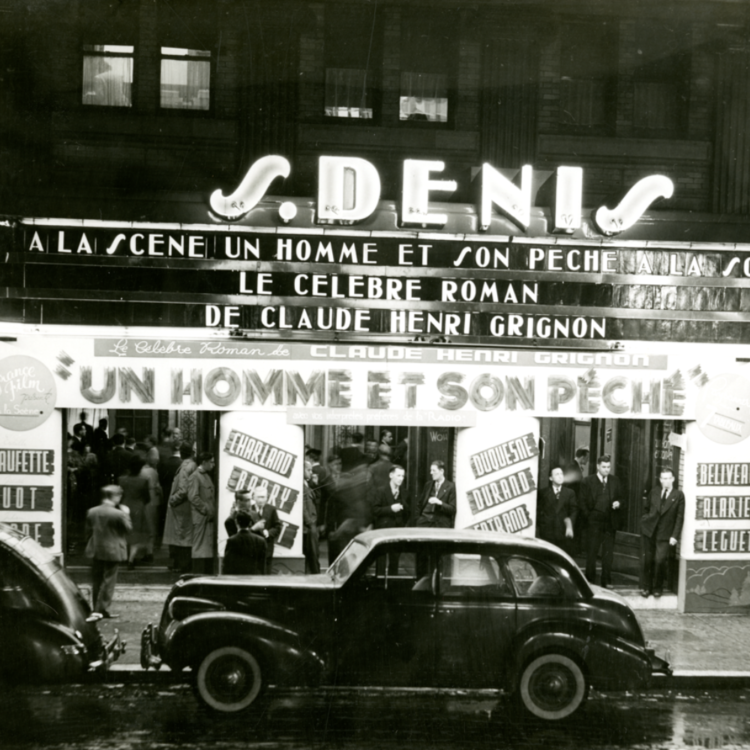
[F]or two weeks, without pause or letup, the public has stormed the box offices of the St-Denis," reported the newspaper La Patrie on September 13, 1942. Tickets were booked at a frantic pace for the performances of Un homme et son péché, a play that opened at Théâtre St-Denis during the first week of September 1942. A crowd of nearly 80,000 passed through the venue's doors to see the characters of Séraphin Poudrier, Donalda Laloge, and Alexis Labranche—already household names thanks to the radio serial broadcast on Radio-Canada for the past three years .
Already immensely popular for its simple, honest, and straightforward characters, La petite histoire des Pays d’en haut captivated audiences with its realistic portrayal of the lives of ordinary people . This success—"the most formidable ever known in the entire history of theatre in Montreal"—was also due to the performances of the cast, who took their roles to heart and delivered the script in a simple, direct, and colloquial language that thrilled the audience
1950
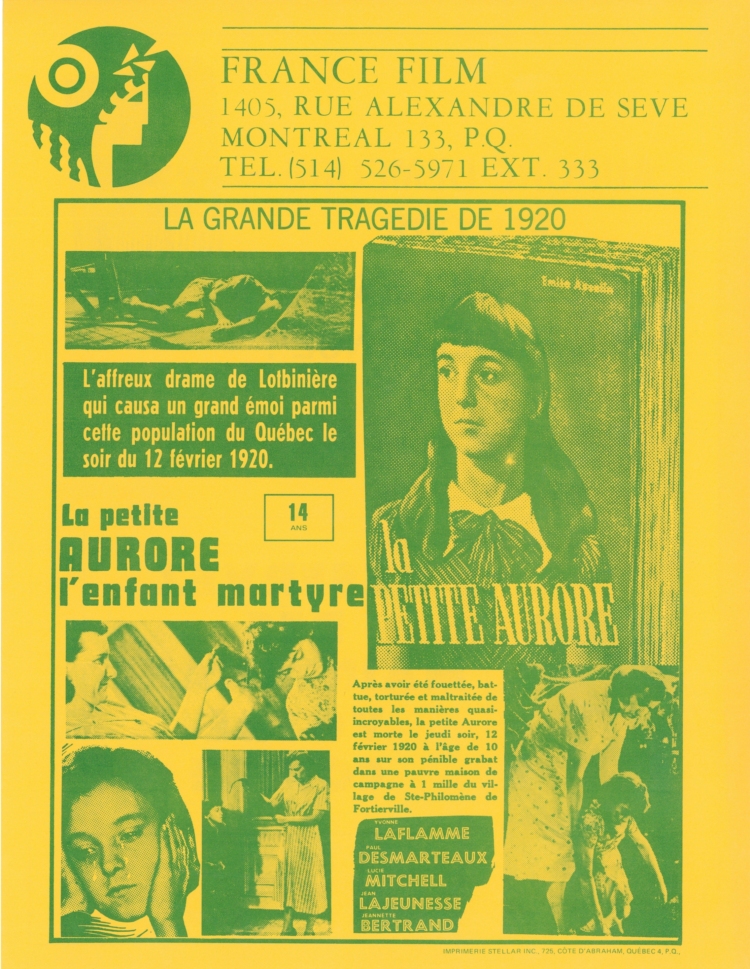
In the entire history of Quebec cinema, no film has sparked as much curiosity as La petite Aurore, l’enfant martyre, produced by the Alliance cinématographique canadienne, which opened at Théâtre St-Denis on Friday, April 25, 1952. Adapted from the novel by Émile Asselin, the film recounts the abuse suffered by young Aurore Gagnon at the hands of her stepmother in the late 1910s. The feature film directed by Jean-Yves Bigras is notable for the quality of its cinematography and the performances of its lead actors: Yvonne Laflamme as Aurore, Lucie Mitchell as the stepmother, and Paul Desmarteaux as the father .
The press also highlighted the efforts made to tell the story "without exceeding the limits of decency" while examining the psychological transformation of a character who was initially good but lost all self-control . The director’s careful attention to the nature of the subject and his approach—avoiding melodramatic tropes to present a simple and humanly true narrative—captivated the theatre’s vast audience and cemented its success, making it the greatest hit in the history of Quebec cinema at the time.
1960
A truly versatile gathering place, Théâtre St-Denis has hosted landmark events, such as the one on February 9, 1960, when Jean Drapeau chose to hold a public conference on current political affairs to announce his election campaign. This speech, broadcast on CKAC radio and delivered before a crowd of 1,500 people, provided Mr. Drapeau with the opportunity to denounce the city's financial management by the previous municipal administration .
According to him, the vital interests of Montrealers were threatened by the "strange money dealings " practiced at City Hall by Mayor Sarto Fournier, who lent millions of dollars to the Mercantile Bank at lower rates than those paid for other loans . To the applause of his audience, he pledged that if re-elected for a second term, he would restore public finances by "permanently eliminating the bankrupts, the profiteers, the crooked politicians, those behind cynical transactions and those who grant them cowardly complacency—the men who work together to ruin both Montreal’s prestige and its credit."
1970
Théâtre St-Denis is in hot water... The concert series by the rock band Beau Dommage, held from December 8 to 14, 1977, resulted in the venue being placed on the American Federation of Musicians' blacklist. The union reprimanded the theatre for non-compliance with the rule prohibiting its members from performing on a stage that also hosts non-affiliated artists. Beau Dommage and other Quebec artists—including singer Félix Leclerc, the theatre troupe Le Grand Cirque Ordinaire, and storyteller Jocelyn Bérubé—firmly refused to join this American union [i]. For Beau Dommage, it was unthinkable to answer to a foreign association "that claims to be able to represent the interests of Quebec musicians when all decisions come from New York [ii]"!
Théâtre St-Denis, however, did not bow to the demands of the American Federation of Musicians and hosted the group anyway. The band presented its third and fourth LPs [iii] in a singularly strange setting "under pink neon lights and the fragrance of a wine fountain [iv]."
1980
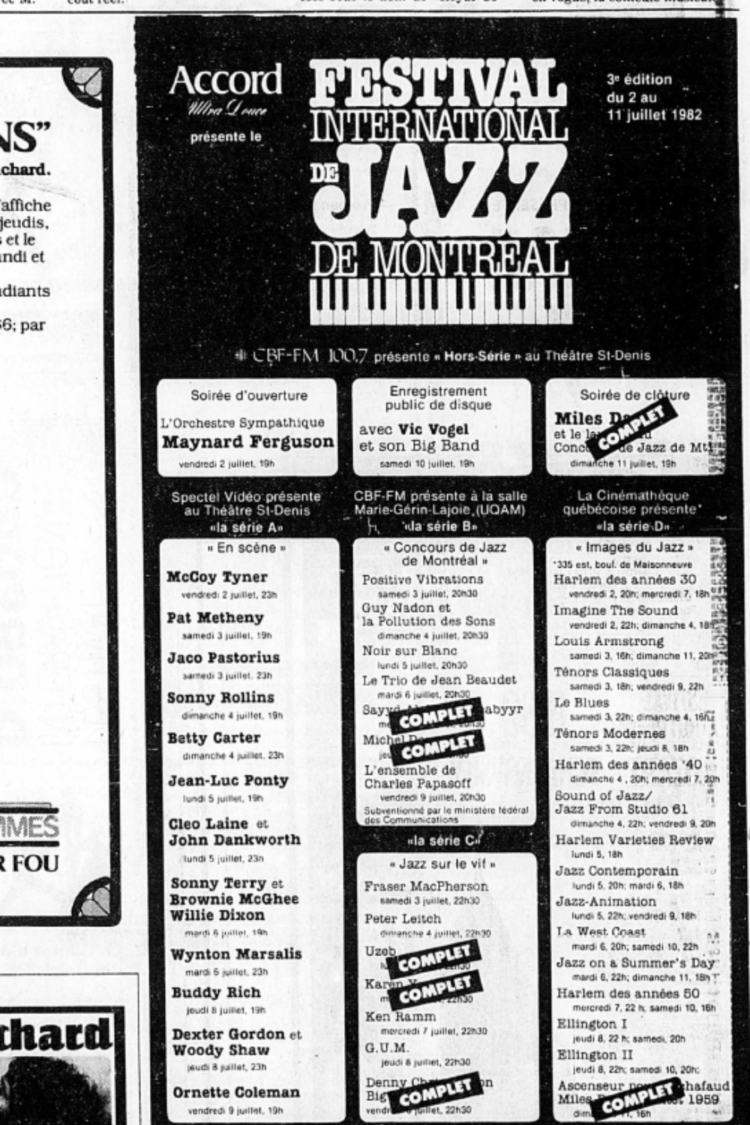
For its third edition, held from July 2 to 11, 1982, the Festival International de Jazz de Montréal moved from Cité du Havre to "Village Saint-Denis [i]," located on Saint-Denis Street between De Maisonneuve and Ontario, which was turned into a pedestrian zone for the occasion [ii]. Festival organizers expected nearly 50,000 spectators to fill the downtown core and the various areas of the site [iii].
The festivities took place primarily at Théâtre St-Denis, which hosted the headlining shows; at UQAM’s Salle Marie-Gérin-Lajoie, which welcomed local musicians; and at the Cinémathèque québécoise, which screened films for jazz fans. The celebration also spilled out into the streets, as several smaller-scale performances were held in neighboring bars and restaurants [iv]. The location—chosen for its proximity to the metro, the bus terminal, and various restaurants [v]—aimed to bring more color and vibrancy to the Festival [vi]. The organizers thus hoped to create "a true festival atmosphere that one can breathe in every evening on Saint-Denis Street [vii]" for ten days in the area surrounding Théâtre St-Denis.
1990
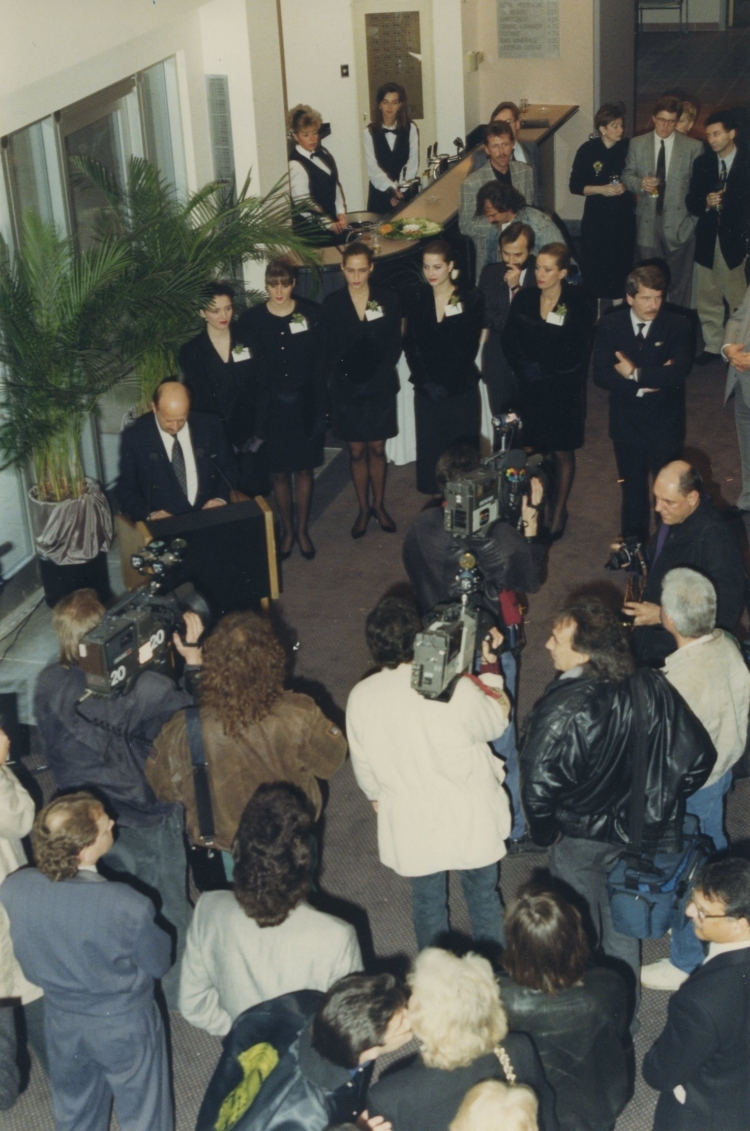
"Théâtre Saint-Denis has just entered a new era with a fresh look to open itself up to the Year 2000," as reported in the newspaper La Presse in April 1990! Transformed into a construction site between September 1989 and April 1990, the theatre's owner, France-Film, invested $8.5 million in renovating its infrastructure. Led by architects Franco Ruccolo and Josée Faubert, the work primarily aimed to widen the lobby, centralize the box offices, expand the halls, create new dressing rooms for performers, and modernize the equipment—all while preserving the venue's original charm .
The most significant improvement was the expansion of the performance halls: St-Denis 1 could now accommodate 2,353 people, while St-Denis 2, created by unifying the two former cinemas, could seat 946 . These major expansions provided the theatre with greater flexibility for designing large-scale productions, as well as additional space for storing sets and stage equipment . On January 26, 1990, the Montreal public was invited to admire the freshly renovated theatre during a performance by singer Jean Lapointe in St-Denis 1; St-Denis 2 was later inaugurated by comedian André-Philippe Gagnon on April 4 of the same year.
2000
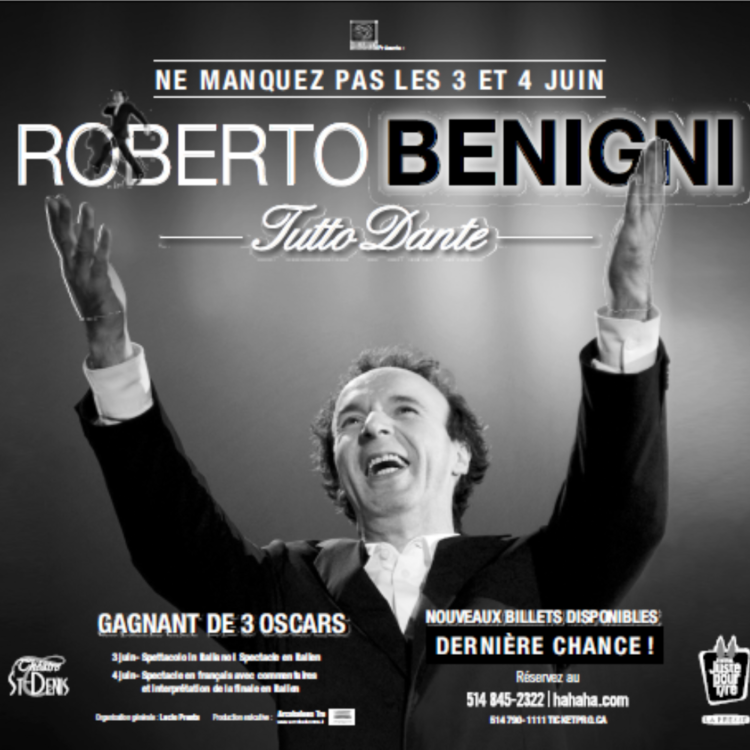
Théâtre St-Denis, which has hosted the Just for Laughs Festival on numerous occasions since 1985, has seen the biggest names in comedy grace its stage, including Roberto Benigni. At the festival’s invitation, the three-time Oscar-winning Italian director, actor, and screenwriter presented his show Tutto Dante there—first in Italian on June 3, then in French on June 4, 2009. In this performance, he playfully and passionately explores poet Dante Alighieri’s The Divine Comedy . His set, preceded by a few jokes about current events, begins with amusing antics that combine jabs at Roman politicians with humor about God, Quebecers, and poutine . Benigni "plays his role as a quintessential Italian and gets laughs accordingly, while juggling national clichés " to the great delight of the audience.
He then sets about deconstructing Dante’s text. He first focuses on the 5th Canto, which deals with lust, by recounting the misadventures of historical figures swept away by passion. Despite the character’s extravagance and exuberance, it is the moment he abandons the farce to focus on Dante’s text that strikes spectators most with its simplicity , which "[w]ith a gravity, a poignant emotion […] confers a quasi-sacred feeling upon the evening."
2010
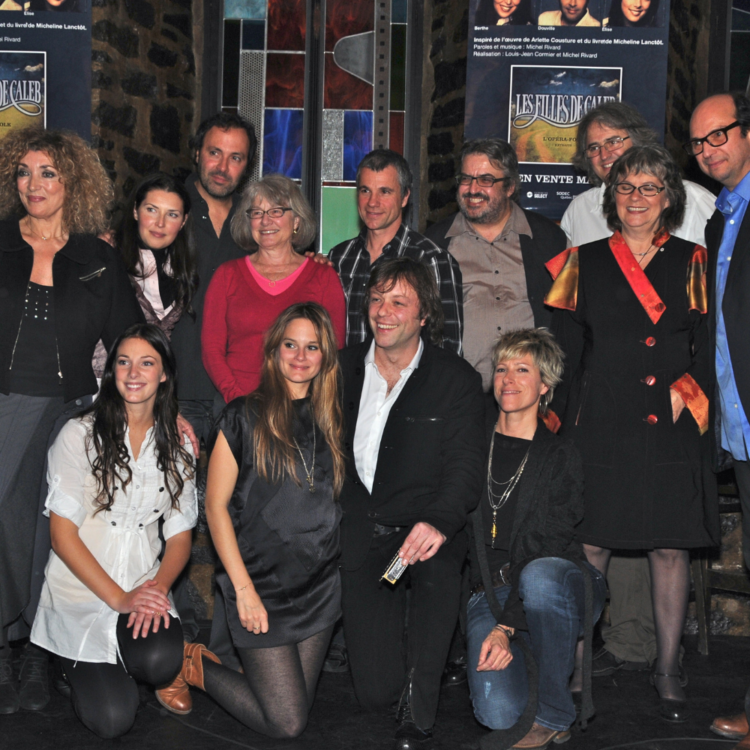
More than 25 years after the publication of Arlette Cousture’s bestselling novel and 20 years after the broadcast of the legendary TV series that followed, Les filles de Caleb arrived on the stage of Théâtre St-Denis in the form of a folk opera. From April 12 to 30, 2011, audiences were reunited with the characters of Émilie Bordeleau and Ovila Pronovost, portrayed by Luce Dufault and Daniel Boucher, in a production that was both theatrical and musical , bringing together artists from the worlds of theatre and song .
With music by Michel Rivard and a libretto by Micheline Lanctôt, the show features the protagonists in their forties, looking back at their past as well as their current lives, condensing 100 years of history into a performance of about 100 minutes . In addition to its run of shows at Théâtre St-Denis, the production was presented at Southam Hall in Ottawa’s National Arts Centre in July 2011.
2020
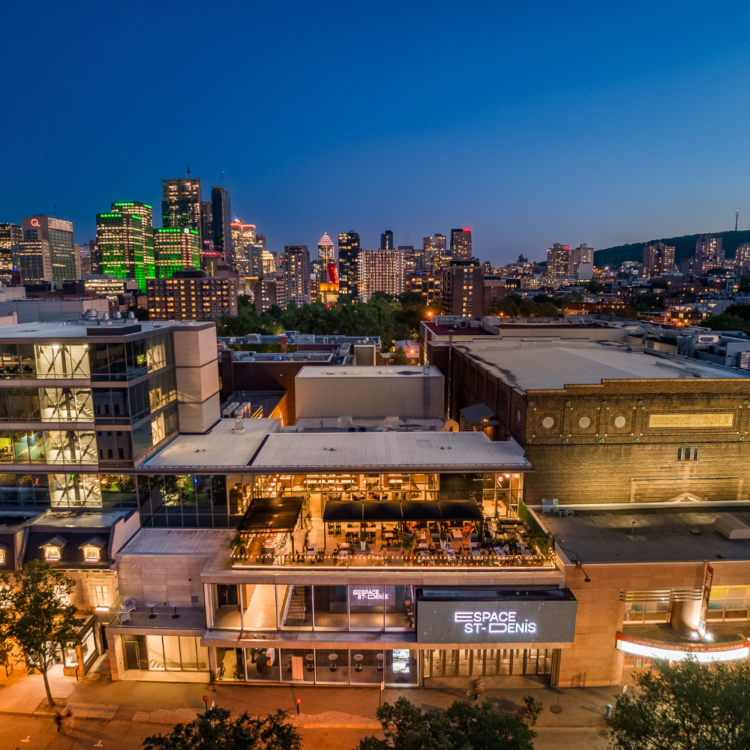
Since the summer of 2020, Théâtre St-Denis and its various structures have undergone significant transformations to become Espace St-Denis—a premier entertainment and dining complex stretching from De Maisonneuve Boulevard to Émery Street. The space brings together two performance halls, Théâtre St-Denis and Studio St-Denis, as well as administrative offices, the Cinéma du Quartier Latin, and several versatile venues capable of hosting business events, charitable activities, and festive gatherings.
The vibrancy of the complex, which offers culture in all its forms, comes amid a period of high foot traffic in the area; 6.5 million people walked along Saint-Denis Street in 2024, a significant portion of whom entered Espace St-Denis, which sold nearly 300,000 tickets in 2025. This energy is primarily driven by the rich programming of Théâtre St-Denis, the true cornerstone of Espace St-Denis and the engine of its identity. As the historical anchor of the complex, the theatre provides the foundation and scope for everything that has been developed here in recent years.
In 2026, the celebrations surrounding its 110th anniversary will offer a unique opportunity to showcase its facilities, which are set to undergo a major revitalization over the coming years. Multi-million dollar investments will modernize the building to current standards, ensuring its longevity while preserving the richness of its architectural heritage. This major transformation will mark a key milestone in the renewal of the Latin Quarter, beginning with the revitalization of this iconic venue. After 110 years, Théâtre St-Denis remains a leading landmark—an essential destination that contributes fully to Montreal’s prestige as the Francophone cultural capital of Canada.
CREDITS
Graphic Design: Alain Bolduc – B Graphistes
Linguistic Revision: Karen Dorion Coupal
Canada Research Chair in Urban Heritage – UQAM Historical and Iconographic
Research: Gabrielle Pomerleau
Research Coordination: Julie Rose
Research Direction: Lucie K. Morisset
BIBLIOGRAPHY
- « 2e semaine des “Trois Masques” au Théâtre Saint-Denis », Le Petit Journal, Montréal, 8 juin 1930, p. 20.
- « Beau Dommage et la Guilde des musiciens », Le Courrier du Sud, Longueuil, 14 décembre 1977, p. 8.
- « De la Cité du Havre au village St-Denis », La Voix de l’Est, Granby, 27 mai 1982, p. 25.
- « Inauguration officielle du nouveau Saint-Denis », Le Devoir, Montréal, 6 avril 1990, p. 18.
- « “La Petite Aurore, l’Enfant martyre” », Le Devoir, Montréal, 24 avril 1952, p. 6.
- « Le discours de M. Drapeau sera diffusé par CKAC », Le Devoir, Montréal, 8 février 1960, p. 3.
- « “Les Trois Masques” au théâtre S.-Denis », La Presse, Montréal, 28 mai 1930, p. 10.
- « M. Jean Drapeau candidat à la mairie », La Presse, Montréal, 10 février 1960, p. 3.
- « Me Jean Drapeau dénonce un étrange commerce de l’argent : Montréal emprunte à prix fort pour prêter des millions à la banque (!) de M. Asselin », Le Devoir, Montréal, 10 février 1960, p. 1.
- « Miles Davis, Maynard Ferguson, Buddy Rich et Cleo Laine au Festival de Jazz de Montréal », La Presse, Montréal, 2 juin 1982, p. 7.
- « Saint-Denis – “La Petite Aurore, l’enfant martyre” », Le Petit Journal, Montréal, 27 avril 1952, p. 75.
- « Seconde semaine des “Trois Masques” au Théâtre Saint-Denis. », La Patrie, Montréal, 9 juin 1930, p. 8.
- « Triomphe incontestable d’“Un homme et son Péché” », Montréal-Matin, Montréal, 5 septembre 1942, p. 6.
- BLAIS, Marie-Christine, « Les femmes de Caleb », La Presse, « Arts et spectacles », Montréal, 2 avril 2011, p. 10-11.
- JOANISSE, Marc André, « Encore un an avant son passage à Ottawa : un opéra folk pour “Les filles de Caleb” », Le Droit, Ottawa-Gatineau, 2 juin 2010, p. 37.
- LAMON, Georges, « Le Saint-Denis fin prêt pour les nouveaux défis », La Presse, Montréal, 6 avril 1990, p. 9.
- LAVOIE, Denis, « 20 millions $ ont été investis au théâtre Saint-Denis et à la salle Wilfrid-Pelletier », La Presse, Montréal, 17 février 1990, p. 4.
- LAVOIE, Denis, « La rue Saint-Denis se convertit au jazz pour dix jours », La Presse, Montréal, 3 juillet 1982, p. 1.
- LAVOIE, Denis, « Le jazz envahit Montréal », La Presse, Montréal, 3 juillet 1982, p. 9.
- LAVOIE, Denis, « Le Saint-Denis, une autre Place des Arts… », La Presse, Montréal, 21 novembre 1989, p. 8.
- LESAGE, Valérie, « “Les filles de Caleb” : mariage de comédiens et de chanteurs », La Presse, Montréal, 8 avril 2010, p. 1
- PETROWSKI, Nathalie, Le Devoir, « Variétés », Montréal, 3 décembre 1977, p. 51.
- SARFATI, Sonia, « Le clown au service du poète », Le Soleil, Québec, 3 avril 2009, p. 39.
- TREMBLAY, Odile, « Tutto Dante : Entre pantalonnade et gravité », Le Devoir, Montréal, 5 juin 2009, p. 2.
- « Au Théâtre Saint-Denis », Le Nationaliste, Montréal, 5 mars 1916, p. 7.
- « Au Théâtre Saint-Denis », Le Devoir, Montréal, 7 mars 1916, p. 5.
- « Deux Grands Concerts », La Patrie, Montréal, 23 mars 1921, p. 12.
- « Au St-Denis », L’Autorité, Montréal, 1er juin 1930, p. 3.
- « Au St-Denis », L’Autorité, Montréal, 8 juin 1930, p. 3.
- « Un homme et son péché », La Patrie, Montréal, 3 septembre 1942, p. 17.
- « Sélections », Le Jour, Montréal, 9 décembre 1977, p. 37.
- « “Un Homme et son Péché” », La Patrie, Montréal, 8 septembre 1942, p. 8.
- « Le départ de la Scala est encore remis », La Presse, 23 mars 1921, p. 19.
- « Le dernier concert de Toscanini », La Presse, Montréal, 22 mars 1921, p. 11.
- « 3e concert de Toscanini, ce soir », Le Canada, Montréal, 24 mars 1921, p. 3.
IMAGE CREDITS AND CAPTIONS
In order of appearance
- Grande ouverture aujourd’hui
- Crédit : Bibliothèque et Archives nationales du Québec, Le Devoir, Montréal, 4 mars 1916, p. 3.
- Légende : Encart publicitaire dans Le Devoir du 4 mars 1916. Image : Bibliothèque et Archives nationales du Québec.
- Trois photos de l’intérieur du Théâtre
- Crédit : Archives du Théâtre St-Denis, Vues de l’intérieur du Théâtre St-Denis, 1916-1929
- Légende : Vues de l’intérieur du Théâtre St-Denis entre 1916 et 1929. Photos : Archives du Théâtre St-Denis.
- Plan de façade
- Crédit : Archives du Théâtre St-Denis, Plan de la façade du Théâtre Saint-Denis, Barott, Blackader & Webster, Montréal, 1915.
- Légende : Plan de la façade du Théâtre St-Denis dessiné par le bureau d’architectes Barott, Blackader & Webster à Montréal en 1915. Image : Archives du Théâtre St-Denis.
- Photo de façade
- Crédit : Archives du Théâtre St-Denis, Vue de la façade du théâtre, vers 1930.
- Légende : Vue de la façade du théâtre vers 1930. Photo : Archives du Théâtre St-Denis.
- Scala di Milano
- Crédit : Bibliothèque et Archives nationales du Québec, 0002737512, La Scala Orchestra of Milan et Arturo Toscanini. Production : J. A. Gauvin : Théâtre St-Denis, Montréal, 22 mars 1921.
- Légende : Programme du spectacle La Scala Orchestra of Milan et Arturo Toscanini au Théâtre St-Denis le 22 mars 1921. Image : Bibliothèque et Archives nationales du Québec.
- Les trois masques – grande innovation à Montréal
- Crédit : Bibliothèque et Archives nationales du Québec, 0000082812, La Presse, Montréal, 31 mai 1930, p. 65.
- Légende : Encart publicitaire dans La Presse du 31 mai 1930. Image : Bibliothèque et Archives nationales du Québec.
- Les trois masques – une vue parlante en français
- Crédit : Bibliothèque et Archives nationales du Québec, 0000164399, Le Petit Journal, Montréal, 1er juin 1930, p. 18.
- Légende : Encart publicitaire dans Le Petit Journal du 1er juin 1930. Image : Bibliothèque et Archives nationales du Québec.
- Photo de la troupe
- Crédit : Archives du Théâtre St-Denis, Un homme et son péché, Théâtre St-Denis, 1942.
- Légende : Photo de la troupe de la pièce Un homme et son péché le soir de la première en septembre 1942. Photo : Archives du Théâtre St-Denis.
- Photo de la façade
- Crédit : Bibliothèque et Archives nationales, fonds Claude-Henri Grignon, MSS246/037/092, Annonce de la pièce Un homme et son péché au Théâtre Saint-Denis, septembre 1942.
- Légende : Façade du Théâtre St-Denis annonçant la pièce Un homme et son péché en septembre 1942. Image : Bibliothèque et Archives nationales du Québec, fonds Claude-Henri Grignon.
- La petite Aurore
- Crédit : Archives du Théâtre St-Denis, Affiche du film « La petite Aurore, l’enfant martyre », France-Film, 1952.
- Légende : Affiche du film La petite Aurore, enfant martyre produit par France-Film en 1952. Image : Archives du Théâtre St-Denis.
- Architecture – Façade 1950
- Crédit : Archives du Théâtre St-Denis.
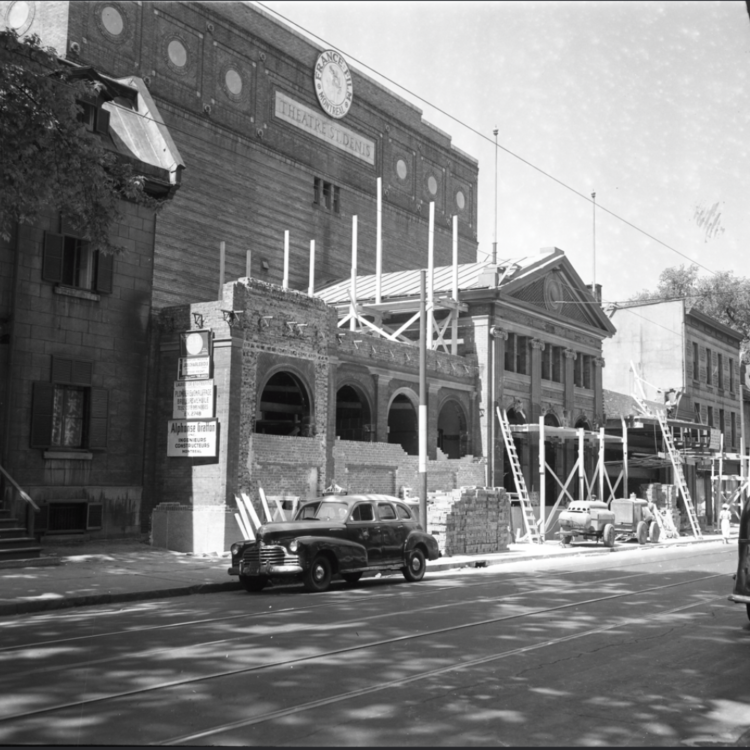
- Légende : Vue du Théâtre St-Denis dans les années 1950. Photo : Archives du Théâtre St-Denis.
- Architecture – Façade 1970
- Crédit : Archives du Théâtre St-Denis.
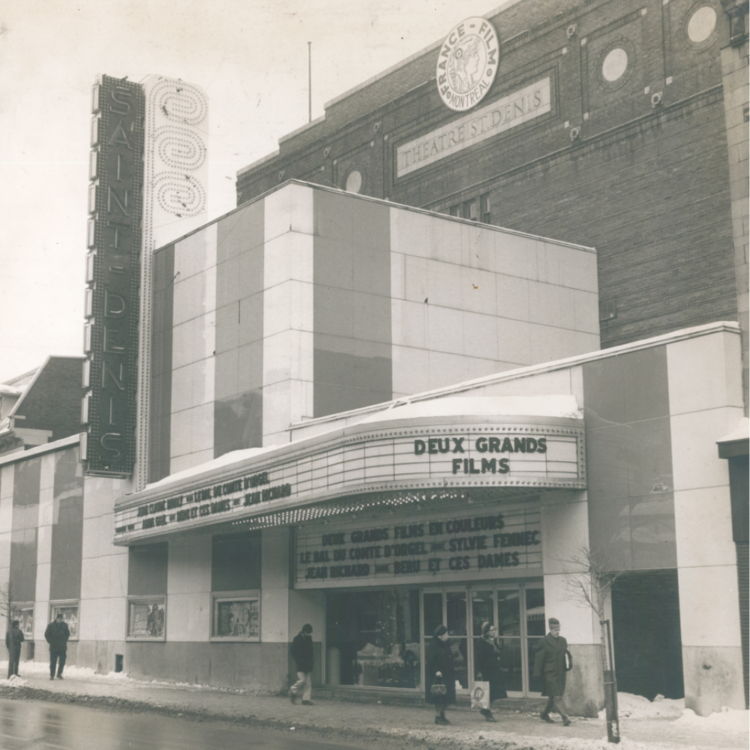
- Légende : Vue du Théâtre St-Denis dans les années 1970. Photo : Archives du Théâtre St-Denis.
- Jean Drapeau
- Crédit : Bibliothèque et Archives nationales du Québec, 0005226335, Le Devoir, Montréal, 8 février 1960, p. 3.
- Légende : Encart publicitaire annonçant la conférence du maire Jean Drapeau dans Le Devoir du 9 février 1960. Image : Bibliothèque et Archives nationales du Québec.
- Beau dommage
- Crédit : Bibliothèque et Archives nationales du Québec, 0006755357, Le Jour, Montréal, 9 décembre 1977, p. 31.
- Légende : Encart publicitaire pour une série de concerts de Beau Dommage dans Le Jour du 9 décembre 1977. Image : Bibliothèque et Archives nationales du Québec.
- Festival de Jazz
- Crédit : Bibliothèque et Archives nationales du Québec, 0000082812, La Presse, Montréal, 3 juillet 1982, p. 10.
- Légende : Encart publicitaire pour le Festival International de Jazz de Montréal dans La Presse du 3 juillet 1982. Image : Bibliothèque et Archives nationales du Québec.
- Travaux de 1990
- Crédit : Archives du Théâtre St-Denis, Inauguration du nouveau Théâtre St-Denis, 6 avril 1990. Normand Jolicoeur.
- Légende : Conférence de presse le 4 avril 1990 pour souligner l’inauguration du Théâtre St-Denis après les rénovations. Photo : Normand Jolicoeur / Archives du Théâtre St-Denis.
- Benigni – Marche
- Crédit : Bibliothèque et Archives nationales du Québec, 0000082812, La Presse, « Arts et spectacles », Montréal, 30 mai 2009, p. 20, p. 3.
- Légende : Encart publicitaire dans La Presse du 30 mai 2009 pour le spectacle Tutto Dante de Robert Benigni. Image : Bibliothèque et Archives nationales du Québec.
- Benigni – Tutto Dante
- Crédit : Bibliothèque et Archives nationales du Québec, 0000082812, La Presse, « Arts et spectacles », Montréal, 30 mai 2009, p. 20, p. 3.
- Légende : Encart publicitaire dans La Presse du 30 mai 2009 pour le spectacle Tutto Dante de Robert Benigni. Image : Bibliothèque et Archives nationales du Québec.
- Filles de Caleb
- Crédit : Archives du Théâtre St-Denis, Distribution de l’opéra-folk « Les filles de Caleb », Théâtre St-Denis, 2011.
- Légende : Photo de la distribution de l’opéra-folk Les filles de Caleb en 2011. Photo : Archives du Théâtre St-Denis.
- Façade récente
- Crédit : Romain Fontaine pour Espace St-Denis.
- Légende : Photo de la façade en 2023. Photo : Romain Fontaine / Espace St-Denis.